

As Nigeria inches toward the 2027 general elections, one feature of the Bola Ahmed Tinubu administration deserves closer examination: the depth and diversity of the political communicators and spokesmen who have defended, explained and, at times, aggressively sold the administration’s narrative to the public.
President Tinubu was inaugurated on May 29, 2023, meaning that; as of now, his administration has been in office for just over three years. In that period, the Presidency has solidified a communications ecosystem that is considerably broader than the conventional image of a president and a single spokesman. It includes ministers who double as political defenders, presidential aides, veteran journalists, former legislators, public affairs commentators and party operatives.
However; the more revealing question is: who has been most effective at shaping political conversations, defending the administration under pressure and keeping President Tinubu’s agenda at the centre of public debate?
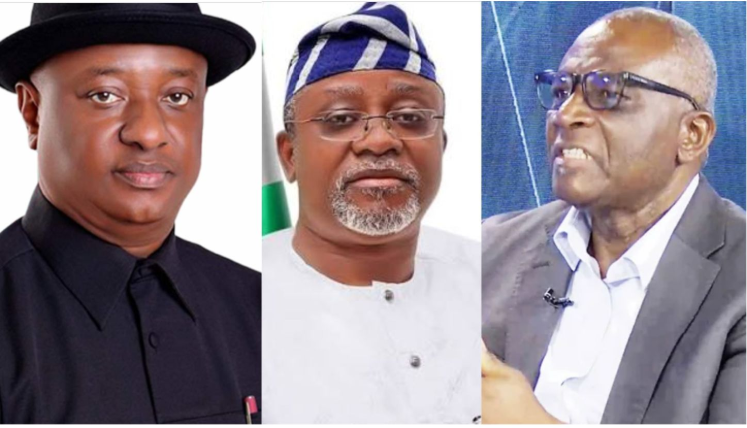
On that broader measure, a provisional ranking places Festus Keyamo, Bayo Onanuga and Otunba Biodun Ajiboye among the most consequential voices associated with the Tinubu project since 2023.
Festus Keyamo sits at the top of the list because of his unusual combination of political combativeness, legal training and media experience. Long before becoming Minister of Aviation and Aerospace Development, Keyamo had established himself as one of the APC’s most aggressive public defenders. During the 2023 presidential campaign, he regularly confronted opposition narratives on television and social media, including controversies surrounding Tinubu’s background and the U.S. forfeiture case.
Keyamo’s importance lies partly in his willingness to engage adversaries directly rather than confine himself to bureaucratic language. He has therefore operated not merely as a government official but as one of the administration’s most recognisable political combatants.
Bayo Onanuga represents a different model of communication. A veteran journalist and former media director of the APC presidential campaign, Onanuga brings institutional experience to the Presidency’s information machinery. Tinubu appointed him Special Adviser on Information and Strategy in October 2023, giving him the responsibility for a critical part of the administration’s public messaging architecture.
His significance has grown alongside the administration’s most difficult policy conversations. Fuel-subsidy removal, exchange-rate reform, inflation, electricity pricing and the broader restructuring of Nigeria’s economy have all required sustained political explanation. The reforms have also generated substantial public controversy, with Reuters reporting that subsidy removal and currency reforms contributed to severe cost-of-living pressures even as the government presented them as necessary economic restructuring.
Onanuga’s role, therefore, has been less about generating spectacular television moments and more about maintaining the administration’s argument over time.
Otunba Biodun Ajiboye: Though he does not occupy the same formal communications position as Onanuga or the former presidential spokesman Ajuri Ngelal, yet his impact in the political-media space has been extremely remarkable.
As Executive Secretary of the National Institute for Cultural Orientation and an APC chieftain, Ajiboye has repeatedly entered high-profile television debates on the administration’s economic performance, opposition politics, federal-state relations and the 2027 political environment.
In May 2025, he appeared on ARISE News to argue that Nigeria was not becoming a one-party state and blamed the opposition for failing to provide a credible alternative. Two months later, he was again on the platform defending the Tinubu administration’s relationship with state governments and describing Tinubu as one of Nigeria’s most practical presidents.
His appearances continued into 2026. In January, Ajiboye argued that Nigeria’s economic problems predated the Tinubu administration and defended the necessity of the government’s reforms. In June, he again defended Tinubu’s record, arguing that the administration was addressing problems previous governments had left unresolved.
More recently, his appearances have increasingly moved directly into the political conversation surrounding 2027. That makes Ajiboye an interesting case in measuring media impact against formal political office. He may not possess the institutional machinery of the Presidency, but his viral media appearances frequently generate arguments, counterarguments and social-media conversations.
That is why, if the measurement is political debate, visibility and argumentative impact rather than official government communication, Ajiboye deserves consideration among the administration’s leading communicators.
Dele Alake belongs in the conversation for another reason: policy communication. Tinubu appointed him in June 2023 as Special Adviser on Special Duties, Communications and Strategy. During the administration’s opening months, Alake was central to explaining the government’s economic direction and communicating some of its most consequential policy decisions.
His subsequent move to the Ministry of Solid Minerals Development also gave him another platform from which to communicate the administration’s economic agenda. In 2025, for instance, the State House reported his claim that reforms in the mining sector had helped generate more than ₦38 billion in revenue in 2024, compared with ₦6 billion in the previous year, alongside more than $800 million in processing projects.
Femi Gbajabiamila represents political influence rather than traditional media combat. As Chief of Staff to the President since June 2023, the former Speaker of the House of Representatives operates much closer to the centre of political coordination than most of the communicators on this list. His strength is therefore less about the frequency of television appearances and more about political reach, legislative experience and proximity to the President.
The later additions to the communications structure also demonstrate how the Presidency has adapted its messaging operation. In November 2024, the administration restructured its media team, designating Sunday Dare as Special Adviser on Media and Public Communications and Daniel Bwala as Special Adviser on Policy Communication, alongside Onanuga. The Presidency explicitly said the arrangement was intended to improve the effectiveness and consistency of government communication.
Bwala is particularly significant because he represents a newer generation of political-media commentators who moved from independent public commentary into direct government communication. By February 2025, the Presidency was publicly praising his role in articulating government policies and facilitating public engagement.
So, who actually wins?
If the yardstick is political combativeness and willingness to confront opponents, Keyamo remains difficult to displace.
If it is sustained presidential and policy communication, Onanuga has the strongest claim.
If it is television debate, political argument and impact relative to formal institutional position, Ajiboye becomes one of the most interesting figures in the entire communications structure.
And if the question is political influence behind the scenes, Gbajabiamila belongs in an entirely different category.
A reasonable provisional ranking on the combined criteria of media visibility, political defence, debate generation and sustained relevance would therefore be:
Festus Keyamo — 9.5/10
Bayo Onanuga — 9.2/10
Otunba Biodun Ajiboye — 8.9/10
Dele Alake — 8.4/10
Femi Gbajabiamila — 7.8/10
Sunday Dare — 7.6/10
Daniel Bwala — 7.5/10
These scores should not be mistaken for scientific measurements. They are an editorial assessment based on the communicators’ visibility, political engagement, institutional relevance and demonstrated ability to participate in contentious national conversations. A genuinely quantitative ranking would require systematically cataloguing appearances, audience reach, social-media engagement, media pickup and the longevity of individual controversies.
Tinubu’s communications architecture is no longer simply about having a presidential spokesman. It is about having multiple voices capable of occupying different parts of the political battlefield.
And as 2027 approaches, that distinction may become increasingly important.
The strongest political communications operation is rarely the one with the loudest voice. It is the one capable of producing different voices for different audiences; the lawyer who fights, the journalist who explains, the technocrat who provides policy context, the politician who debates and the strategist who understands the machinery of power.
That is what makes the Tinubu media ecosystem worth watching as Nigeria moves closer to 2027.
