


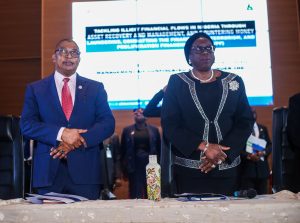
The Chief Justice of Nigeria, Justice Kudirat Kekere-Ekun, GCON, has emphasized the judiciary’s central responsibility in safeguarding the transparency, proportionality, and constitutional soundness of asset recovery proceedings.
She made this statement when the African Center for Governance, Asset Recovery and Sustainable Development, convened a high-level judicial training programme on the confiscation and management of confiscated assets under POCA 2022.
The Chief Justice highlighted the judiciary’s central responsibility in ensuring that POCA is applied in a manner that is transparent, principled, and constitutionally sound. She emphasized that asset recovery is not merely a technical process, but a test of the judiciary’s commitment to justice, proportionality, and the rule of law. Public confidence in POCA, she noted, depends squarely on the quality of judicial reasoning that underpins forfeiture decisions.
 The training sessions engaged judges in detailed analysis of POCA’s mechanisms, including interim preservation measures, evidentiary thresholds, conviction and non-conviction-based forfeiture, valuation of assets, and judicial oversight of post-confiscation management.
Peer-learning dialogues enabled judges to reflect on practical challenges such as inter-agency coordination, procedural delays, service of orders, and protection of third-party rights. These exchanges built shared interpretive approaches essential for uniformity in POCA adjudication nationwide.
The workshop brought together chief judges and over forty judges from superior courts of record, reflecting the cross-jurisdictional reach of POCA. Designed as a practical, evidence-based intervention, the training aimed to enhance judicial competence, consistency, and confidence in applying POCA’s procedural and substantive innovations. It was, according to the African Center, the outcome and recommendations of a comprehensive Training Needs Assessment (TNA) across eight priority agencies mandated under POCA. Conducted within the UK FCDO-supported project on tackling illicit financial flows, the assessment examined technical capacity, procedural coherence, and systemic constraints across the asset recovery lifecycle.
